Tuesday, 5 April 2016

How will I incorporate the 21st century literacies into my own practice?

Photo created by Vincent Bracco
As discussed in my previous blogs the traditional literacies of reading, writing and arithmetic are expanding and changing to the new 21st century literacies that are displayed in the photo to the right. Within this blog post I will be discussing what each one of these eight literacies are and give an example as to how I plan to use them within my Health and Physical Education (HPE) classroom as a future educator.

Technological Literacy
According to Redhead and Robinson (2016), “Technological Literacy is embodying the knowledge and skills necessary to function within a social construct dominated by technological innovation”. Therefore it is the ability to be able to properly use and understand the different forms of technology. One way that I plan to use
Retrieved from: https://plus.google.com/109841953527642776577/posts
this literacy within my HPE classroom is through an application software discussed by Mr. Kennedy's blog called Fresh Grade.  Fresh grade is a e-portfolio software that allows students to self-document their learning as well as allows the teacher and parents to track the students learning and progress. This is a secure software that can ensure privacy of each and every student (FreshGrade, 2015). Within my HPE class I think I could incorporate it for the students to set goals in fitness, track what they are doing each week in class and see if they can reach their goals by the end of the year. As discussed in my last blog, I would also use the application remind that allows a teacher to communicate with privacy through text messages to the students and parents. This can be used to send reminders home for upcoming assignments or any changes that have been made for an upcoming class. Since it is a text message the students and parents receive it right away rather than an email that they might not see (Remind, 2016). A third way that I plan to incorporate technological literacy into my HPE classroom is through the use of fitness apps and softwares. As discussed in Mr. Doyle's blog post he uses the fitness software called Polar GoFit Heart Rate Monitor System. This system allows the students to keep track of their heart rates and to show the students how hard they are working. I could see myself using a system like this to help students keep track of their workouts as well as create a culminating assignment where they are to set goals and keep record of what they are doing through fitness in order to obtain these goals. This culmination will incorporate multiple other literacies as well.

Financial Literacy 
Retrieved from: http://www.communityenv.org/financial-literacy/
According to the Ontario Ministry of Education Financial literacy will allow students to "understand how to make informed financial decisions. Financial literacy builds students' understanding of personal finances, the local and global economy and the results of their choices as consumers"(2016). The Ontario Ministry of Education provides multiple resources for teachers in order to help them gain insight on how to implement this literacy into their subject area. I plan to incorporate financial literacy into my classroom  through the culmination project discussed in technological literacy. I will add an aspect of the culmination where students are to create a food plan along with their fitness plan and determine the financial costs that will be required to follow their plan. They will learn about what foods are healthy and how each group affects their body within the health unit and then they will be required to add meal plans along with their fitness plan.

Moral Literacy 
According to Bertolino and Chant (2016) "The skills and knowledge specific to making ethical choices are learned capabilities requiring skills in which individuals can be more or less competent". I plan to incorporate moral literacy into my HPE classroom in multiple ways. One way I would incorporate moral literacy is in health. Through discussions about steroid usage as well as diet plans that are unhealthy for the body. Another way I would teach moral literacy is through friendly competition and discussing ethical situations within sports so the students gain a sense of sportsmanship.
Retrieved from:https://www.emaze.com/@ALRRCWII/21st-Century-Literacies-in-My-Classroom
Media Literacy 
According to Minow and King (2016) "medial literacy is the ability to access, analyze and evaluate the many complex messages presented through the mass media". I plan to use a similar activity to that discussed by Ms. Fawcett within her blog. Ms. Fawcett discusses an article activity where she focuses lessons on analyzing and dissecting articles that have been carefully selected by her. I plan to use a similar type of activity for my class where I show images and articles about diets and steroid uses and have the students dissect these images that are being portrayed as the ideal body on media and what the
harm can be if you try to thrive for this body type the wrong way. This will also be tied into my moral
Retrieved from: http://www.medialit.org/reading-room
/media-literacy-education-technological-age
literacy idea. I will then use this to teach the students how to healthily lose weight or gain weight. This will also tie into my culmination because they will have to discuss the information they learnt through the photos to provide proof as to why their goals are realistic and healthy ways to gain or lose weight.

Mental Health Literacy 

Skre et al. (2013) "defines mental health literacy as: a) recognition of mental disorder, knowledge and belief about b) risk factors and causes, as c) self-help interventions and d) professional help available, as e) attitudes which facilitates recognition and appropriate help seeking, and finally as f) knowledge about how to seek mental health information" (p.2).  I plan to implement mental health literacy into my health class by bringing awareness to the students about the different disorders and giving them the knowledge needed in order to know what to do when faced with a situation. I plan to give the students the information that meets the criteria of all six aspects discussed within the definition in order to ensure they are mental health literate. 

Global Literacy 
According to Nair, Norman, Tucker and Burkert (2012), "global literacy is a self-reflective understanding of one's responsibilities as a local and global citizen" (p.56). Therefore I would plan to 
Retrieved from: http://www.certiport.com/portal/
desktopdefault.aspx?page=common/pagelibrary/
cov090108-GlobalLiteracy-Guatemala.htm
create activities that can describe and explain specific events within the world in order to teach he 
students about being a global citizen while participating in physical activities at the same time. Focusing on matching activities and warm up activities would be the best way to incorporate global literacy in my opinion. 

Multicultural Literacy 
Multicultural literacy is "to uncover the assumptions of knowledge, to view knowledge from diverse ethnic and cultural perspectives, and to use knowledge to guide action that will create a humane and just world” (Tkovic and Mukhtar, 2016). Therefore I plan to incorporate this literacy by playing sports from all around the world. To introduce my students to the different major sports and activities from other cultures. Within my undergrad at Brock University I took a physical education course where we got to play cricket. It was my first time playing cricket and I found it was a lot of fun because it was not a traditional sport. Therefore I want to implement sports like this that can teach my students about the different cultures and allow them to experience their sports. 
Retrieved from: https://www.emaze.com/@ALRRCWII/
21st-Century-Literacies-in-My-Classroom

Environmental Literacy 
According to Sickle and Vos (2016) being environmentally literate "is the capacity of an individual to act successfully in daily life on a broad understanding of how people and societies relate to each other and to natural systems, and how they might do so sustainably. This requires sufficient awareness, knowledge, skills and attitudes in order to incorporate environmental considerations in daily decisions about consumption, lifestyle, career and civics, and to engage in individual and collective actions". I plan to incorporate this literacy into my classroom by teaching the students about the five essential components to being environmentally literate. I plan to teach them these through interesting subjects by incorporating sports and the fields/courts that the sports take part on in order to gain their attention on the specific subject that can typically be boring to some students.

Summary 
Therefore it is evident through the information that I have discussed about above that I have begun planning ways in order to incorporate the new 21st century literacies into my classroom as a future Health and Physical Educator. I plan to continue creating and finding other ways to incorporate the literacies even further into my classroom. As I enter this profession I will be able to try these examples and reflect on the results in order to determine how effective they are and if any of my integrated activities for these literacies need to be modified. 

Cheers, 

Mr. Bracco  


References 

Bertolino, A., & Chant, B., (2016). Moral Literacy. [Powerpoint Slides].

Doyle, M., (2014, December, 02). How I Teach. Retrieved from: http://www.thephysicaleducator.com/blog/files/how-i-teach-mike-doyle.html

Fawcett, D., (2012, December, 28). Literacy in PE. Retrieved from: http://reflectionsofmyteaching.blogspot.ca/2012/12/literacy-in-pe.html

Freshgrade, (2015). Retrieved from: https://www.freshgrade.com

Kennedy, C., (2015, October, 8). It Just Works. Retrieved from: http://cultureofyes.ca/page/3/

Minow, K., & King, K., (2016). Media Literacy. [Powerpoint Slides].

Nair, I., Norman, M., Tucker, G. R., & Burkert, A., (2012). The Challenge of Global Literacy. Perspectives. Retrieved from: https://lms.brocku.ca/access/content/group/EDUC4P29D03FW2015MAIN/Literacies/Global%20Literacy/Nair%20et%20al.%20_2012_.pdf

Ontario Ministry Of Education. (2016). Financial Literacy Education in Ontario Schools. Ontario, Queens Printer. Retrieved from: https://www.edu.gov.on.ca/eng/surveyLiteracy.html

Redhead, S., & Robinson, J., (2016). Technological Literacy. [PDF Document]. Retrieved from: https://lms.brocku.ca/access/content/attachment/EDUC4P29D03FW2015MAIN/Forums/d8fec4f0-3af4-4ded-b7f9-c56e8470fdac/Technology%20Literacy.pdf

Remind101, (2016). Retrieved from: https://www.remind.com

Sickle, V. V., & Vos, Q., (2016). Environmental Literacy. [Powerpoint Slides].

Skre, I., Friborg, O., Breivik, C., Johnsen, L. I., Arnesen, Y., & Wang, C. E. A., (2013). A school intervention for mental health literacy in adolescents: effects of a non-randomized cluster controlled trail. BMC Public Health, 13, 873. Retrieved from: https://lms.brocku.ca/access/content/group/EDUC4P29D03FW2015MAIN/Literacies/Mental%20Health%20Literacy/Skre%20et%20al.%202013.pdf

Tkovic, I., & Mukhtar, N., (2016). Multicultural Literacy. [Powerpoint Slides].

Wednesday, 4 November 2015

Literacy: It Is More Than The Traditional Three R's


Elementary school and high school for me focused on being able to read, write and do arithmetic. These three R's together made up the definition of literacy (Drake, Reid, Koholon, 2014). Literacy is a main goal of education and therefore every student in Ontario in grade 10 is required to successfully complete an Ontario Secondary School Literacy Test or Course (OSSLT) in order to be eligible to graduate. The OSSLT only focus' on the reading and writing aspects of literacy however, literacy in the 21st century has become much more. Literacy today according to Drake, Reid and Koholon (2014) has expanded into including new interdisciplinary literacies. 

Retrieved from: https://sites.google.com/a/mail.csuchico.edu/21st-century-literacy/
These new interdisciplinary literacies according to Drake, Reid and Koholon (2014) will allow students to gain the 21st century skills (such as critical thinking, communication, and computer and digital technologies) that are needed "for students to participate fully in a constantly changing world"(p.107). 
Retrieved from: http://www.besteducationresources.com/financial-
literacy-can-help-you-pay-off-your-student-loan-debt.html
In my opinion technology has become a major part of everyday life and therefore, it is important to teach students these new literacies such as critical literacy and media literacy along side the subject literacies in order to prepare them for this complex technological world we live in today. Most people in todays day in age use technology for online banking and this is why I believe financial literacy has become a major topic within education today. In 2011 the Ontario Ministry Of Education implemented financial literacy into the ontario curriculum for grades 4-12 in order to allow students to gain an "understanding  of personal finances, the local and global economy and the results of their choices as consumers" (Ontario Ministry of Education, 2015) . The implementation of financial literacy would ultimately teach students the skills needed to be active whole citizens in the 21st century.  
Retrieved from: https://www.youtube.com/watch?v=15K8F7PHoSo
As discussed in the video students need teachers to understand the world that they are living in and therefore, it is important for teachers to be able to understand and use technology in order to teach these new literacies within the 21st century classroom. The personal experiences that I have gained through my placement courses are both shocking and interesting. What intrigues me the most is the extent to which students are engaging with technology within the classroom. This comes as a surprise to me because I did not have any of these tools or resources when I was a student at that age.  
Retrieved from: https://chrome.google.com/webstore/detail/remind/jppddpkfhdojffabldnpdacpeoefcljp
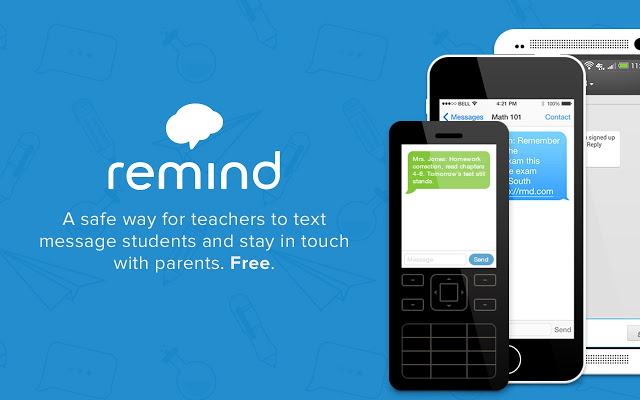
When I had shared with my sister my experiences with technology in the classroom she responded by sharing with me this free application that is used by several teachers today. This application is called Remind and functions to send reminders to both students and parents as a text message. The application does not allow the students to respond to the message and ultimately allows a teacher to use the technology that students are using throughout a daily basis. Recognizing that such softwares are available for teachers has made me realize that in order to prepare my students for the workplace and the real-world today I am going to have to teach myself and learn to effectively teach others about the technology that is integrated into these new literacies.

Consequently, when considering the integration of the new interdisciplinary literacies, the traditional three R's of reading, writing and arithmetic are no longer satisfactory to meeting the needs of students. Rather, it will be more beneficial for students to learn the four E's of expose, employ, express and ethics on the internet (Warlick, 2005). 

Cheers, 

Mr. Bracco 


References 

Drake, S. M., Reid, J. L., & Kolohon, W. (2014). Interweaving Curriculum and Classroom Assessment: Engaging the 21st Century Learner. Don Mills, ON: Oxford University Press

Ontario Ministry of Education. (2013). Financial Literacy Education In Ontario Schools . Retrieved from: http://www.edu.gov.on.ca/eng/surveyLiteracy.html

      Warlick, D., (2005). The New Literacy. Scholastic,. Retrieved from http:// www.scholastic.com/browse/article.jsp?id=263


Thursday, 8 October 2015

Knowing Your Students: The First Step Towards A Relevant Curriculum

Throughout the Concurrent BPhEd (Honours)/ BEd Intermediate Senior program at  Brock University I have had many opportunities within my courses to learn about the importance of getting to know your students differing intelligences and learning styles in order to design a relevant curriculum that meets the needs of each and every student in the class.
Retrieved from:https://www.blendspace.com/lessons/fuk9fneGUZ14NA/multiple-intelligences-learning-about-finding-yours
According to Drake, Reid and Kolohon (2014), a diagnostice assessment is a good assessment tool in order to determine "what students already know and can do, their preferred learning styles and multiple intelligences, and their general interests" (p.53). To determine what  student already knows a teacher could have the students brainstorm on a unit of study within the class describing what they already know, what they are wanting to know and how they would like to learn it. 21st century skills are more and more relevant to education and therefore it is also a good idea to determine the students level of technological skills in order to then be able to incorporate technology into the classroom (Drake, Reid, Kolohon,  2014). 
Retrieved from: http://www.communicationstudies.com/how-technology-in-the-classroom-is-changing

This picture depicting a 21st century classroom with technology being used for learning reminds me of a placement I did for one of my courses at Brock University. Throughout each class the students used iPads, laptops and desktops in order to complete assignments and do homework. I found this very interesting because it was the first time I had ever experienced technology being used to that degree in the classroom. Students were making videos, comic strips and using apps which differed from my learning through handing in essays and powerpoint presentations. All of the students were interested, laughing and having fun while learning the information that was supposed to be taught. 


Retrieved from:https://www.youtube.com/watch?v=b1FC1ZPN7cw

Learning preferences are important for a teacher to understand about each student because it involves learning styles, multiple intelligences, triarchic intelligences and environmental preferences and thus relates to the way a student will learn best in a classroom. Learning styles is the type of learner a student is and there are 3 main kinds; auditory, visual, and kinaesthetic. Multiple intelligences is an idea that intelligence is fixed however, it can be demonstrated through eight different ways (see Picture 1). The Triarchic intelligences states that students have 3 intelligences (analytical, practical, and creative) and each student uses them in different ways. Environmental preferences relates to the setting in which each student learns best in, for example; brightness of the light, in groups or alone, with music or silent, and etc..
Retrieved from:
https://turnermagic.wordpress.com/2011/03/11/how-to-remember-names-the-memory-mojo-way/


After reading Drake, Reid and Kolohon's (2014) chapter 2 from the text I learnt about an important part of getting to know your student that has never really been discussed in my other courses and is usually a topic that is assumed to know. This topic is  about getting to know a students background; what their interests are, what their nationality is, who they are friends with, what extracurricular activities do they participate in, and therefore getting to know a "student's social, cultural and socioeconomic backgrounds" (Drake, Reid, Kolohon, 2014, p.53). In order to find out this information Drake, Reid and Kolohon (2014) state that a teacher should look into the following things (p.52,53):
Retrieve from:
http://www.brainyquote.com/quotes/quotes/a/adorasvita594699.html

  • Review of OSR
  • Consultation with parents 
  • Consultation with previous teachers
  • Consultation with support team
  • Classroom observation checklist 
  • Educational assessments 
  • Multiple Intelligences Survey or Learning Style Inventory 
  • Work samples, assignments and projects 
  • Portfolios 
  • Teacher-student conference 
  • Peer and self assessments
  • Interest surveys 

Therefore after reading chapter 2 by Drake, Reid and Kolohon (2014) I as a future educator plan to know each and every student within my class not only on their knowledge, skills and learning preferences but also on their "social, cultural and socioeconomic backgrounds" (Drake, Reid, Kolohon, 2014, p.53).  In doing so I will be able to form relationships with my student and create a relevant curriculum that will allow maximize success in learning for each and every student. 

References 

Drake, S. M., Reid, J. L., & Kolohon, W. (2014). Interweaving Curriculum and Classroom Assessment: Engaging the 21st Century Learner. Don Mills, ON: Oxford University Press

Cheers, 

Mr. Bracco 


Thursday, 24 September 2015

Gearing towards a project-based learning approach for student success


     Throughout history there has been a clear conflict between traditional and constructivist styles of teaching. This conflict stems from the pedagogical approach in which we as a society believe students learn best. The truth is, each student has their own strengths and weaknesses in learning and thus "a unit of study changes each year because of the uniqueness of the students and the dynamic global issues impacting their world" (Drake, Reid, & Kolohon, 2014, p. 52). By knowing your students' interests and experiences, you as a teacher will then be able to create a relevant curriculum (Drake et al., 2014). With this being said, the development of the students curriculum must exhibit a project based learning approach as opposed to a traditional based learning approach because a traditional based learning approach does not meet the learning needs of each and every student.  
Retrieved from: http://presentlygifted.weebly.com/problem-based-learning.html

      As shown in the picture above, a traditional based learning approach starts with the teacher telling the students what they need to know, followed by the students memorizing it and lastly illustrating how to use it through an assigned problem. Through my own experiences of the traditional learning approach I found that it was not a successful approach for me as I learn better through hands on experiences. I also found that I lacked motivation and simply sat in class to receive the content that was needed for me to then go home and learn it through my own learning strategies. After reading chapter one and learning more about the project-based learning approach, I believe that this approach would meet the different learning needs of each student. The Project-based learning approach would accomplish this because it uses a project as a "vehicle for simultaneous instruction and application" (Drake et al., 2014, p.3). The teacher is to guide the students to use his or her own interests and experiences in order to make connections and bring light to knowledge while working on the project (Drake et al.,2014). 

Retrieved from: http://plpnetwork.com/2012/10/19/venturing-project-based-learning/

Retrieve from http://bie.org/about/why_pbl

      A PBL approach begins with the teacher asking a challenging/ complex question that incorporates the students learning goals, interests, curriculum content and is grounded into the real-world (Coffey, n.d.). According to Drake et al., (2014) the students thus use 21st century skills like inquiry/research, critical thinking, collaboration, communication and problem solving to  research, learn about concepts, gain new knowledge and thus apply this knowledge and concepts  in different ways. These skills are not only beneficial to the specific task at hand, rather, they are applicable to life experiences outside of the classroom. By PBL allowing students to take the learning into their own hands, the student then builds a basis for how they will work within their future life in college, university,  and their career. Therefore PBL ultimately fosters a deeper lifelong learning compared to the traditional learning approach as it encourages students to use technology and become active, reaching out beyond the school building and integrating their skills into the world around us (Edutopia, 2007). 

References

Coffey, H., (n.d.). Project-based learning., Learn NC,. Retrieved from: http://www.learnnc.org/lp/pages/4753

Drake, S. M., Reid, J. L., & Kolohon, W. (2014). Interweaving Curriculum and Classroom Assessment: Engaging the 21st Century Learner. Don Mills, ON: Oxford University Press.

Edutopia, (2007, October 19). Why Is Project-Based Learning Important?. Retrieved from: 

http://www.edutopia.org/project-based-learning-guide-importance


Ee